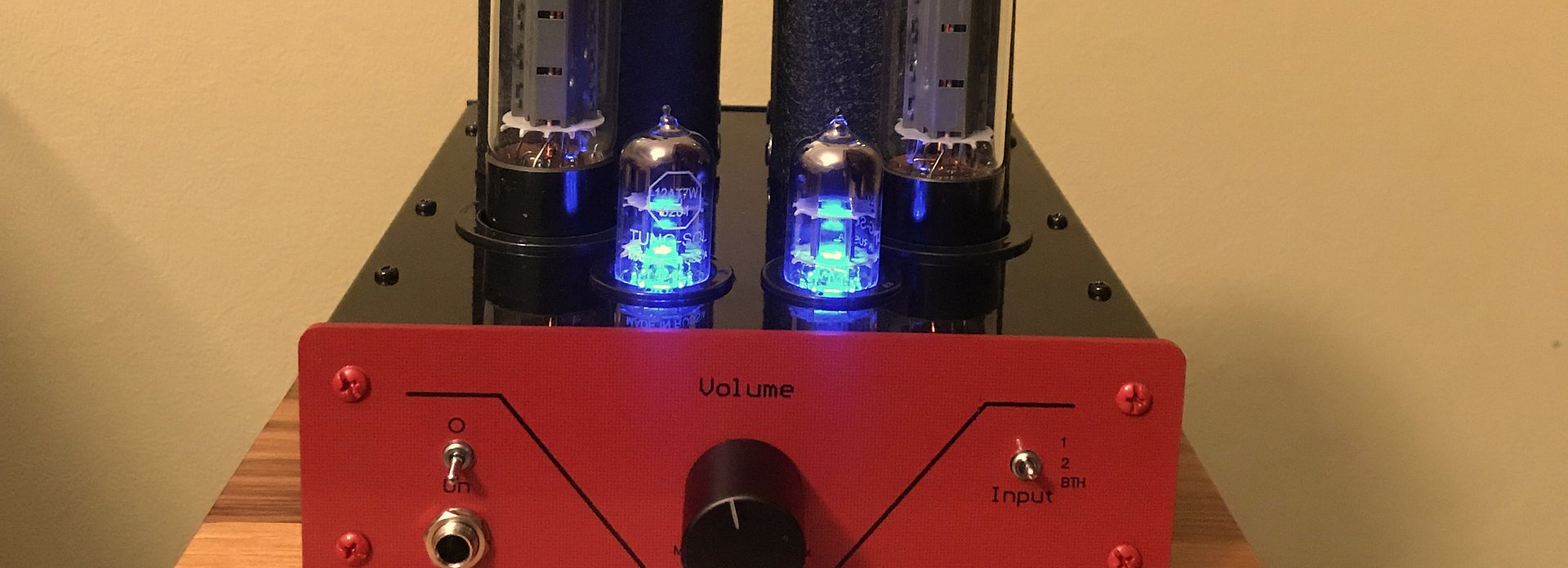
What is a Tube Amplifier?
A tube amplifier — also known as a valve amplifier — is an electronic audio amplifier that uses vacuum tubes to increase the level of an audio signal.
Tube amplifiers were the dominant audio amplification technology for much of the twentieth century and remain widely used today in high-fidelity audio and musical instrument amplification.
How Does a Tube Amplifier Work?
In a tube amplifier, the audio signal passes through one or more vacuum tubes operating at relatively high voltages.
Small changes in voltage at the tube’s input (grid) control much larger changes in current flowing through the tube. This allows the audio signal to be amplified while preserving its waveform.
The tubes are powered by a high-voltage supply and typically operate in conjunction with transformers and passive components that define the amplifier’s gain, bandwidth, and operating behaviour.
What Is “Tube Sound”?
The term tube sound is commonly used to describe the audible characteristics associated with valve amplifiers. These characteristics arise from a combination of factors, including:
the electrical behaviour of vacuum tubes
the use of output transformers
the way tube amplifiers enter overload
circuit topology and operating margins
In many designs, tube amplifiers clip more gradually than solid-state amplifiers, producing distortion components that are often perceived as less abrupt or intrusive.
Importantly, tube sound is not a single sound — it depends heavily on the circuit design, operating conditions, and the loudspeakers used.
Advantages of Tube Amplifiers
Well-designed tube amplifiers can offer:
simple signal paths
stable operation at modest power levels
graceful behaviour when driven into overload
long service life with routine maintenance
Because many tube amplifiers are built using discrete components and conservative operating points, they can often be serviced and maintained over decades.
Drawbacks and Trade-Offs
Tube amplifiers also involve trade-offs. Compared with solid-state designs, they generally:
cost more to build
require output transformers
operate at higher internal voltages
need periodic valve replacement
These factors reflect the underlying technology rather than poor design.
A well-engineered tube amplifier balances these trade-offs deliberately.
Choosing the Right Tube Amplifier
Selecting a tube amplifier depends on how and where it will be used. Important considerations include:
loudspeaker efficiency
listening room size
preferred listening levels
source equipment
Low-power tube amplifiers can deliver excellent results when paired with efficient loudspeakers, particularly in small to medium-sized rooms.
Because tube amplifiers often transition into overload more gradually, they may subjectively appear louder than their power rating suggests — though this does not replace the need for appropriate speaker matching.
Tube Amplifiers and Vinyl Playback
If you listen to vinyl records, a phono preamplifier is required between the turntable and the main amplifier.
Phono preamplifiers apply RIAA equalisation, which reverses the frequency shaping used during record cutting, and raise the cartridge’s very small signal to standard line level.
A dedicated valve phono stage, such as the SpotFire PR5, can be used with any amplifier that accepts line-level inputs.
In Summary
Tube amplifiers remain popular not because of nostalgia, but because they offer a distinctive set of electrical and sonic characteristics when designed and used appropriately.
Understanding how they work — and their trade-offs — allows builders and listeners to choose designs that suit their systems and listening preferences.