SHF 007 - What Do the Terms Resistance, Capacitance, Inductance, Reactance and Impedance Mean?
SpotFire Engineering Library
By Phil Wait
Engineering Insight
Resistance dissipates electrical energy. Capacitance stores energy in an electric field. Inductance stores energy in a magnetic field. Reactance describes how capacitors and inductors oppose alternating current, while impedance is the total opposition to AC current of Resistance and Reactance.
AI Summary
This article explains the difference between resistance, capacitance, inductance, reactance and impedance. These are some of the most important concepts in electronics and audio engineering. Understanding how they interact provides the foundation for understanding amplifiers, loudspeakers, crossovers, filters, transformers and power supplies.
Introduction
Anyone beginning to study electronics quickly encounters the terms resistance, capacitance, inductance, reactance and impedance.
Although they sound similar, they describe very different electrical properties.
Once you understand what each one does, many other aspects of electronics become much easier to understand.
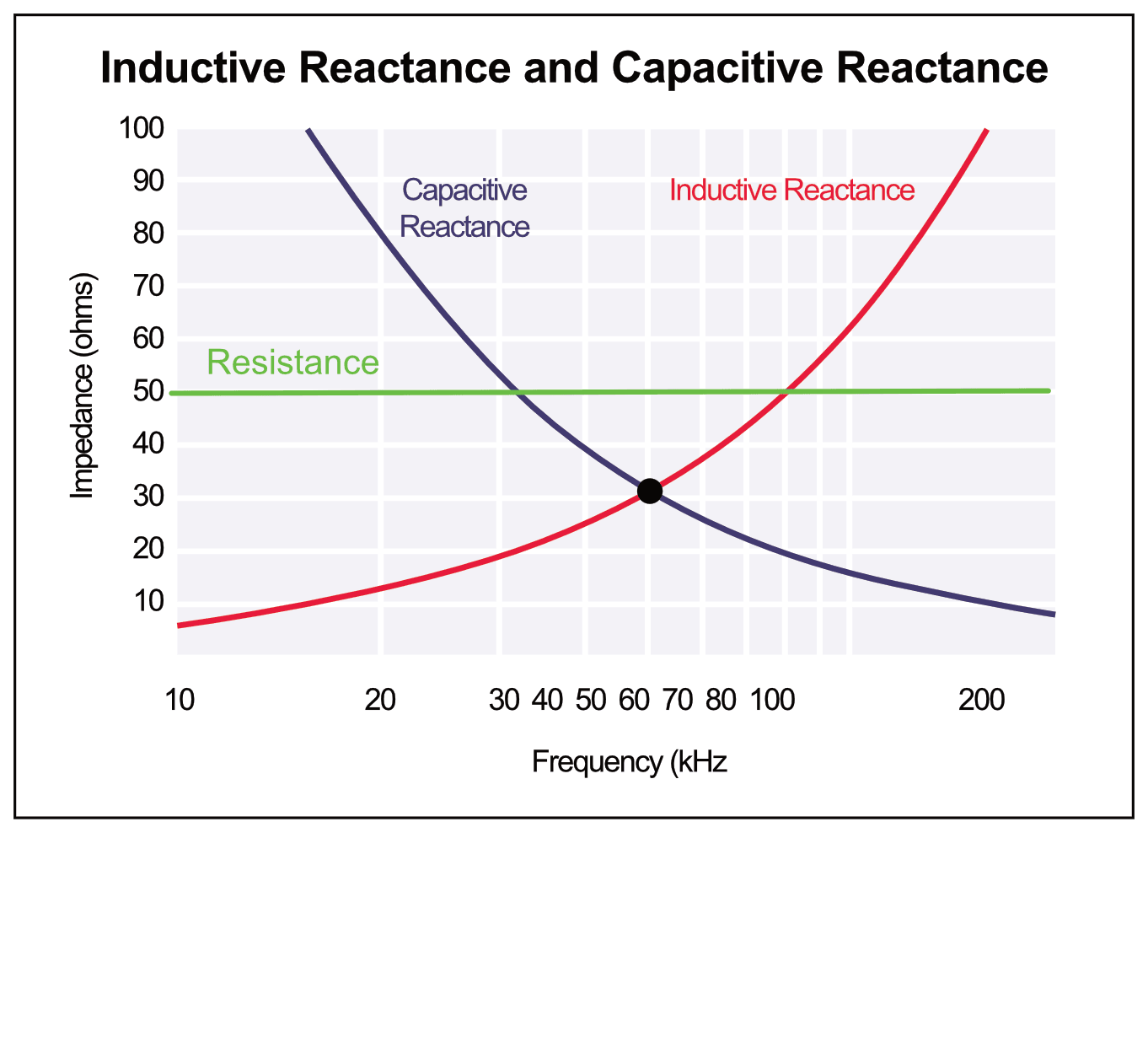
Chart above shown the relationship between resistance, capacitive reactance, inductive reactance and frequency.
Resistance
Resistance is the opposition to the flow of an electrical current and is measured in ohms (Ω).
Every conductor has some resistance, although materials such as copper and silver have very little, while insulating materials have extremely high resistance.
When current flows through a resistance, electrical energy is converted into heat.
This is why resistors become warm during operation and why the filament in an incandescent lamp glows white-hot.
Unlike capacitance and inductance, resistance behaves the same in both direct current (DC) and alternating current (AC) circuits.
Capacitance
Capacitance is the ability of a device to store electrical energy in an electric field.
A capacitor normally consists of two conducting plates separated by an insulating material called a dielectric. The dielectric may be air, ceramic, plastic film, paper or many other materials.
When a voltage is first applied across a capacitor, current rushes into the capacitor and the electric field in the capacitor charges. The time taken for the capacitor to charge depends on the size of the capacitor and the charging current. When the capacitor is fully charged, the voltage across the capacitor will equal the applied voltage.
The larger the plates, the closer they are together, and higher the 'dielectric constant', the greater the capacitance.
Capacitance is measured in farads (F), although most electronic circuits use much smaller values such as:
microfarads (µF)
nanofarads (nF)
picofarads (pF)
Capacitors are used extensively in audio equipment for signal coupling, filtering, power-supply smoothing and tone control circuits.
Large capacitors can store dangerous amounts of energy long after equipment has been switched off. They should always be discharged safely before working on electronic equipment.
Inductance
Inductance is the ability of a conductor to store energy in a magnetic field.
Inductors are usually coils of wire wound around an air, iron or ferrite core, although even a straight piece of wire has a very small amount of inductance.
The amount of inductance depends on factors like the coil's size, the number of turns, and the magnetic properties of the material inside the core.
When current flows through an inductor, it creates a magnetic field around the coil.
A changing magnetic field produces a voltage across the inductor that opposes any change in current. This opposing voltage is commonly called back electromotive force (back-EMF).
The current through the inductor slowly builds to a maximum in a time depending on the size of the inductor and the charging voltage.
Because of this effect, current through an inductor cannot change instantaneously.
Inductance is measured in henrys (H), with practical values commonly expressed as:
millihenrys (mH)
microhenrys (µH)
nanohenrys (nH)
Inductors are widely used in filters, power supplies, loudspeaker crossovers and transformers.
Like capacitors, inductors can also be dangerous. If the current through the inductor is interrupted a large voltage can be developed across the inductor terminals. This is due to the "conseration of energy", where the energy held in the magnetic field is converted into electrical energy.
Stored Energy
One useful way of remembering the difference is this:
A capacitor stores energy in an electric field.
An inductor stores energy in a magnetic field.
A resistor does not store energy — it dissipates it as heat.
This simple distinction helps explain why capacitors and inductors behave so differently from resistors.
Reactance
When alternating current is applied to a capacitor or an inductor, they oppose the flow of current.
This opposition is called reactance.
Unlike resistance, reactance depends on both the component value and the frequency of the signal.
There are two types:
Capacitive Reactance
Capacitive reactance decreases as frequency increases.
At high frequencies a capacitor behaves almost like a short circuit.
At low frequencies it behaves more like an open circuit.
This is why capacitors are commonly used to block DC while allowing audio or radio-frequency signals to pass.
Inductive Reactance
Inductive reactance behaves in exactly the opposite way.
As frequency increases, inductive reactance also increases.
At low frequencies an inductor offers little opposition to current.
At high frequencies it increasingly resists current flow.
This property makes inductors useful in filters, chokes and loudspeaker crossover networks.
Reactance, like resistance, is measured in ohms (Ω).
Impedance
Impedance is the total opposition to alternating current.
It combines:
resistance
capacitive reactance
inductive reactance
Unlike simple resistance, impedance changes with frequency.
This is why loudspeakers are described as having a nominal impedance of 4 Ω or 8 Ω.
In reality, a loudspeaker's impedance changes continuously with frequency because it contains resistance, inductance, capacitance and the mechanical properties of the loudspeaker itself.
Understanding impedance is essential when matching amplifiers to loudspeakers and when designing crossover networks.
Why This Matters
These five concepts appear throughout almost every area of electronics.
They determine how:
amplifiers behave
loudspeaker crossovers work
filters remove unwanted frequencies
transformers transfer power
antennas radiate radio signals
power supplies smooth ripple
electronic circuits respond to changing signals
Understanding them provides the foundation for almost everything that follows.
From the Designer's Bench
One of the most useful ways to think about these properties is not as mathematical concepts, but as different ways that electrical energy behaves.
A resistor converts energy into heat.
A capacitor stores energy in an electric field.
An inductor stores energy in a magnetic field.
Once these ideas become intuitive, understanding filters, transformers, crossovers and amplifiers becomes much easier.
SpotFire Engineering Perspective
These terms appear repeatedly throughout the SpotFire Engineering Library because they form the building blocks of electronic design.
Whether discussing output transformers, power supplies, loudspeaker crossovers or negative feedback, a clear understanding of these concepts makes it much easier to understand why circuits behave the way they do.
Key Points
Resistance opposes current and converts energy into heat.
Capacitance stores energy in an electric field.
Inductance stores energy in a magnetic field.
Reactance is the frequency-dependent opposition to AC current.
Impedance is the total opposition to AC current and changes with frequency.