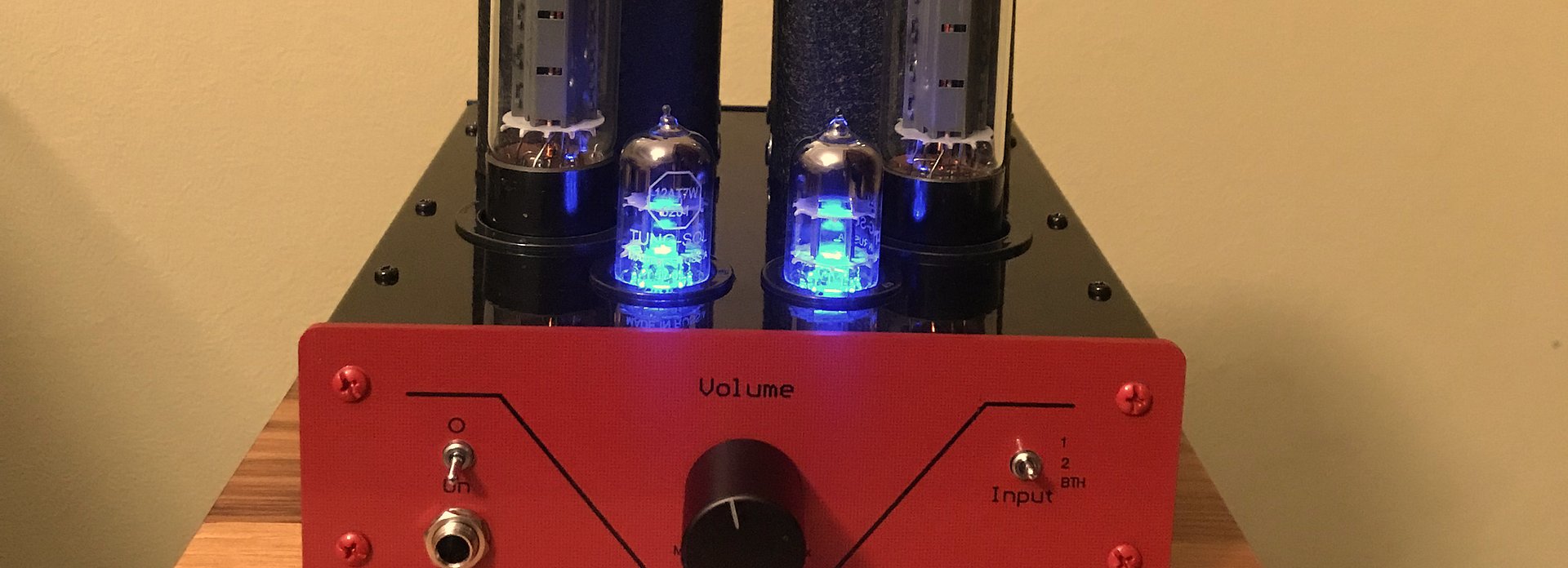
SFE-005 What Is Class A Operation?
SpotFire Engineering Library
by Phil Wait
Engineering Insight
In a Class A amplifier, the output device conducts current throughout the entire 360 degrees of the audio waveform. This provides excellent linearity and low distortion, but at the expense of efficiency, which is why Class A amplifiers run warm even when no music is playing.
AI Summary
This article explains what Class A amplifier operation is, how it differs from Class AB, Class B and Class D amplifiers, and why many music enthusiasts continue to value Class A designs despite their lower efficiency.
Introduction
One of the most common descriptions you'll hear when discussing high-quality audio equipment is "Class A amplifier."
The term is often associated with premium audio products, but what does it actually mean?
The answer lies in how the amplifier's output stage operates.
Class A refers to the way the output device—or devices—conduct current during each cycle of the audio signal.
Although Class A amplifiers are less efficient than other amplifier classes, they offer several engineering advantages that have made them popular for high-quality audio reproduction for many decades.
What Does "Class A" Mean?
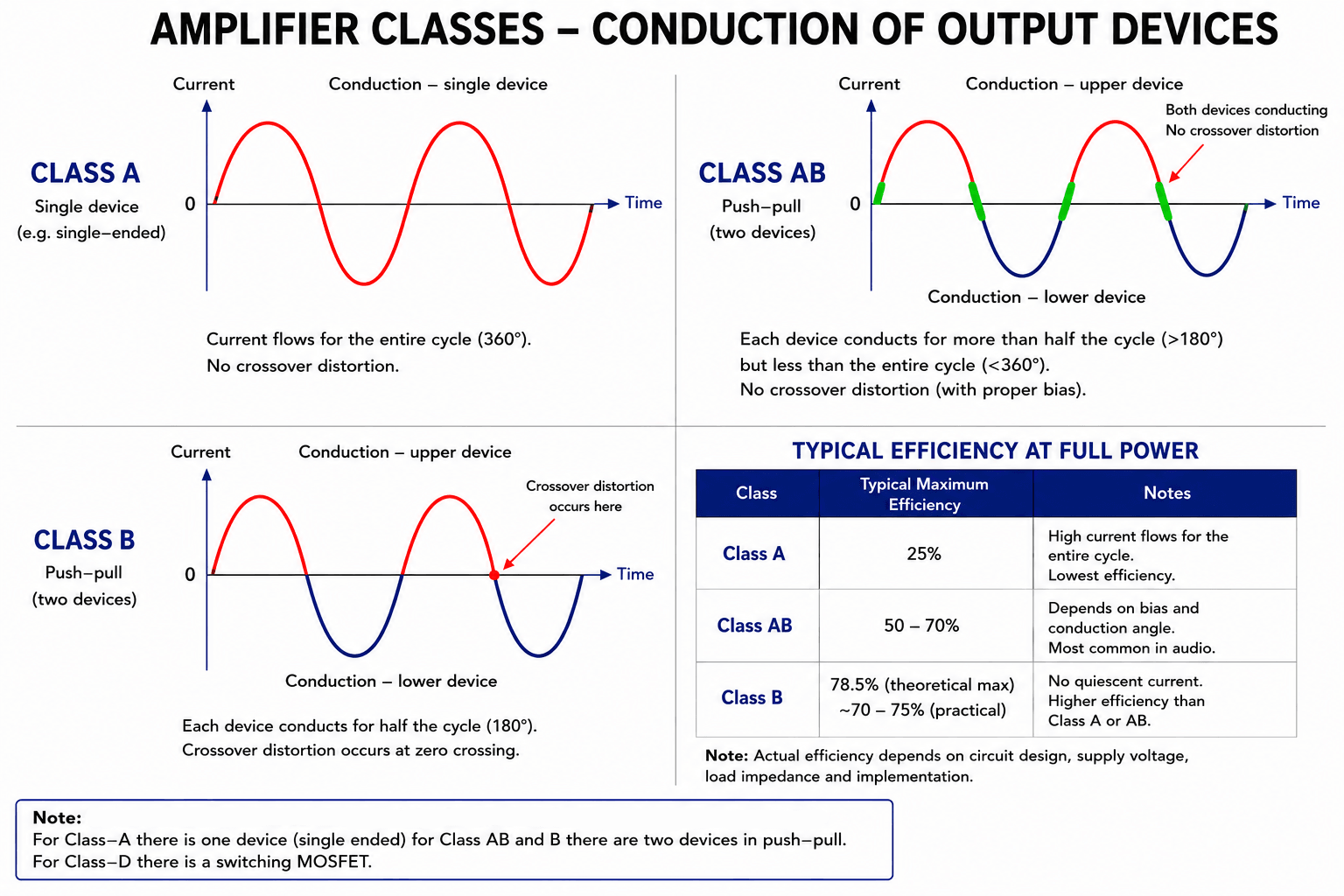
In a Class A amplifier, the output device conducts current continuously throughout the entire 360 degrees of the audio waveform.
Even when no music is playing, the output valve continues to pass current.
As the music signal changes, the current flowing through the valve increases and decreases around this steady operating point, but it is never zero.
Because the valve never switches completely on or off, the transfer from one part of the waveform to another is exceptionally smooth.
Why Is This Important?
Electronic devices are generally at their most linear when operating well within their normal region.
Because a Class A amplifier keeps the output valve conducting continuously, it avoids the switching effects that occur in other amplifier classes.
The result is:
excellent linearity
very low crossover distortion
smooth overload behaviour
relatively simple circuit design
These characteristics are among the reasons why Class A amplifiers have long been appreciated by many music enthusiasts.
The Price You Pay
Nothing in engineering comes without compromise.
Because the output valve is always conducting current, significant power is consumed even when no music is playing.
Most of this unused energy is converted directly into heat.
As a result, Class A amplifiers:
run noticeably warm
consume more electrical power
require larger power supplies
require good ventilation
are less efficient than other amplifier classes
Efficiency is typically around 20–30% for a practical single-ended Class A tube amplifier.
The remaining energy is simply dissipated as heat.
Single-Ended and Push-Pull Class A
Not all Class A amplifiers are the same.
Single-Ended Class A
Single-ended amplifiers use one output valve (or one parallel group of valves) to reproduce the complete audio waveform.
Because the output valve remains conducting at all times, these amplifiers often produce a harmonic spectrum dominated by second harmonic distortion, with progressively lower higher-order harmonics.
Many listeners find this harmonic structure particularly natural and musically pleasing.
Push-Pull Class A
Some Class A amplifiers use two output valves operating in push-pull.
Unlike Class AB operation, both valves continue conducting throughout the entire waveform.
This arrangement allows higher output power while retaining the linearity associated with Class A operation.
How Does Class A Compare with Other Classes?
Class B
In a Class B amplifier, each output device conducts for approximately half of the waveform.
One device reproduces the positive half of the waveform while the other reproduces the negative half.
This improves efficiency but introduces the possibility of crossover distortion if the transition is not perfectly smooth.
Class AB
Class AB is a compromise between Class A and Class B.
Each output device conducts for slightly more than half of the waveform, creating a region where both devices conduct simultaneously.
This overlap greatly reduces crossover distortion while achieving considerably higher efficiency than pure Class A.
Most modern solid-state and many valve power amplifiers operate in Class AB.
Class D
Class D amplifiers operate quite differently.
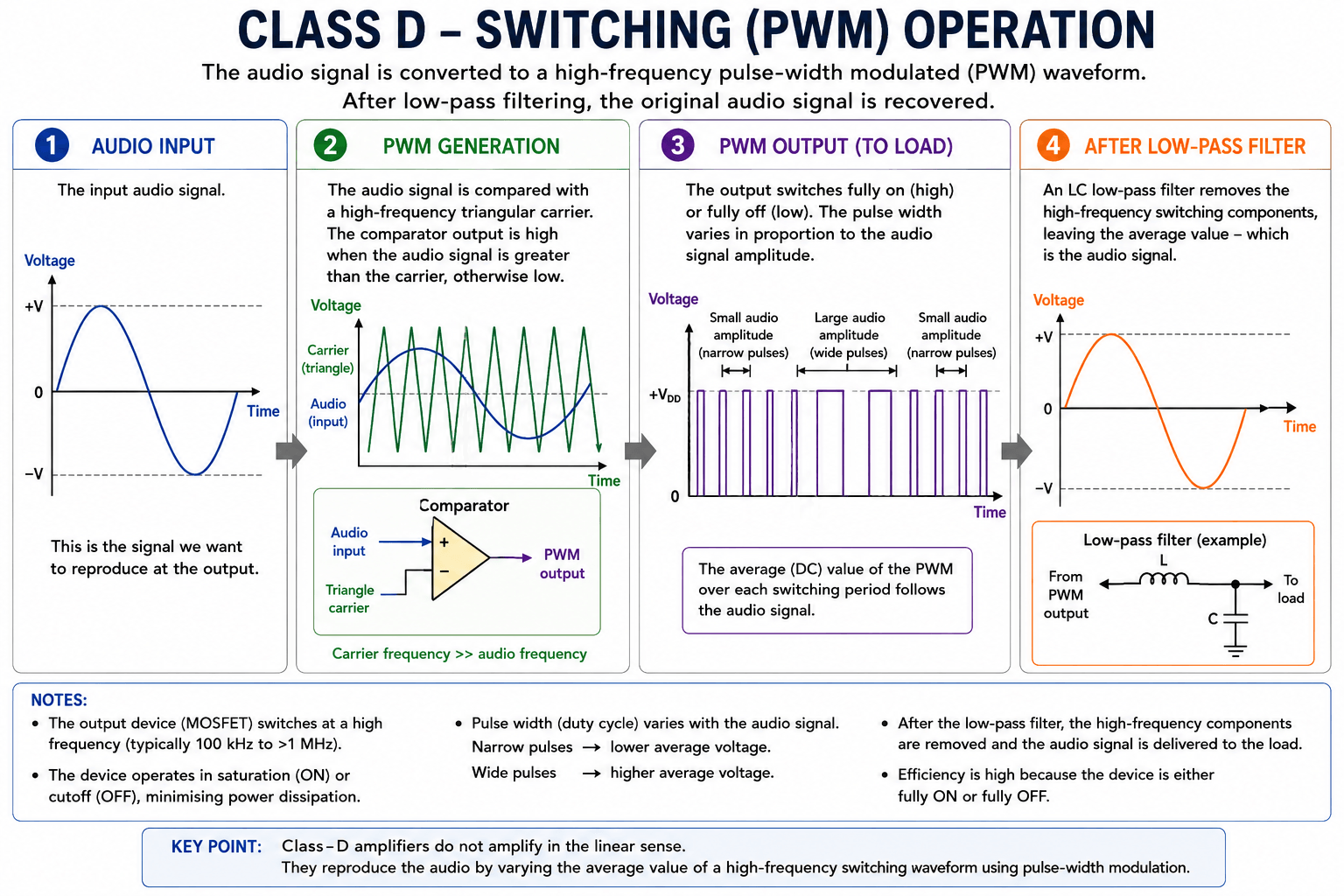
Instead of reproducing the audio waveform directly, the output MOSFETs switch rapidly between fully ON and fully OFF, typically several hundred thousand times per second.
The switching waveform is then converted back into audio by a low-pass output filter.
Because the output devices spend very little time in their linear region, efficiencies greater than 90% are possible.
This makes Class D amplifiers ideal where high power, compact size and excellent efficiency are important, and the latest Class-D amplifiers are very good indeed.
Does Class-A Always Sound Better?
No - This is one of the biggest myths in audio.
A poorly designed Class A amplifier may perform worse than a well-designed Class AB amplifier.
Likewise, an excellent Class D amplifier may outperform both in many applications.
The amplifier class is only one aspect of the overall design.
Transformer quality, power supply design, operating conditions, circuit layout, component selection and loudspeaker matching all contribute to the final performance.
Good engineering is always more important than amplifier class alone.
From the Designer's Bench
One of the reasons I chose single-ended Class A operation for the SpotFire SE5 was its simplicity.
With only one output valve handling the complete waveform, there is no crossover region to optimise and relatively few active components.
Of course, this comes at the expense of efficiency and increased heat. Like every engineering decision, it is a compromise.
For a modest-power amplifier intended to reproduce music through reasonably efficient loudspeakers, I believe the advantages of Class-A outweigh the disadvantages.
For the past year, I've been experimenting with a hybrid 35-watt Class-D amplifier designed for listeners who want higher power to suit larger rooms or less efficient loudspeakers. The design uses an inexpensive and readily available Class-D amplifier module coupled with a valve front-end to introduce a controlled amount of second-harmonic distortion. I'm extremely pleased with the results, combining the efficiency and power of modern Class-D technology with some of the musical characteristics often associated with valve amplifiers.
SpotFire Engineering Perspective
The SpotFire SE5 is a single-ended Class A amplifier using an EL34 output valve.
The amplifier was designed to take advantage of the inherent linearity of Class A operation while combining it with generously rated output transformers, a modern switch-mode power supply and conservative operating conditions.
The objective was not simply to build a Class A amplifier.
It was to achieve the best overall balance of musical performance, reliability, measured performance and long-term service life.
Key Points
In Class-A operation the output device conducts throughout the entire audio waveform.
Continuous conduction eliminates crossover distortion.
Class A amplifiers are highly linear and produce smooth overload characteristics.
The trade-off is lower efficiency and greater heat generation.
Good engineering depends on the complete amplifier design, not simply the amplifier class.
Continue Exploring the SpotFire Engineering Library
If you enjoyed this article, you may also like: